



ORGANS OF PARIS © 2026 Vincent Hildebrandt HOME ALL ORGANS



In the middle of the 19th century, following the sharp
increase in the population of this industrial district, an
additional place of worship was needed. Like many
churches in Paris, the Second Empire took care of it.
Notre-Dame-de-la-Gare was built between 1855 and
1864 by architect Claude Naissant (1801-1879). The
style chosen was roman of the late 12th century.

C1
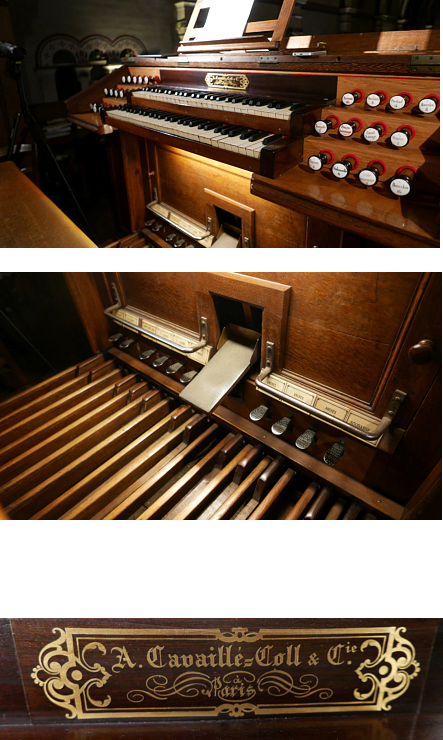
Thanks to a donor, the parish received the present Grand
Organ, built by Cavaillé-Coll in 1863.
Originally, it was not intended for this church. It was
probably meant for a convent near Saint-Omer, but the
original specification, the case, and even the finely crafted
bench (with lyres on the sides) suggest a salon organ. It had
22 stops on two 54-note manuals and a 25-note
pedalboard, used only by coupling to the manuals.
It was overhauled in 1881 by Cavaillé-Coll.
In 1904, Charles Mutin carried out an overhaul:
•
he replaced the window console with a detached
console;
•
he installed a Barker machine;
•
he extended the pedal compass to 30 notes;
•
he added a 16' Soubasse and an 8' Flute, using part of
the façade pipes, which were then unused;
•
in the Récit, the Clairon was shifted to Trompette, and
the Piccolo was replaced by a Nazard, marked as Quinte
on the console.
In 1928, restoration work was entrusted to Gaston
Gutschenritter:
•
the manuals were extended to 56 notes;
•
a 4' pedal Flute was added;
•
a Barker machine was added to the Grand Orgue.
In 1943, further work was carried out by Gutschenritter:
•
he added a 32' Soubasse to the pedal, with the first
octave borrowed from the 16' Soubasse, completed by
12 pipes of 10 2/3' Quinte;
•
the voicing was adjusted, especially for the Plein-Jeu and
Cornet;
•
the organ’s original pitch was 435 Hz, and it was raised
to 440 Hz, probably by Gutschenritter or Haerpfer.
Between 1982 and 1985, a further overhaul was carried out
by Haerpfer, Gutschenritter-Masset. The pedal division was
rebuilt with mechanical transmission.
In 1995–1997, restoration was carried out by Daniel Kern. A
new pedal division was installed, and the voicing was partly
reworked.




Organistes titulaires
Lucile Dollat et Louis Jullien
Parish website
Photos
buffet : Hilaire Champeaux (facebook)
console : Vincent Hildebrandt
1863 - Cavaille-Coll (1)
1881 - Cavaille-Coll (6)
1904 - Mutin (5)
1928 - Gutschenritter (6)
1943 - Gutschenritter (3b)
1984 - Gutschenritter-Masset/Haerpfer (6)
1997 - Kern (5)
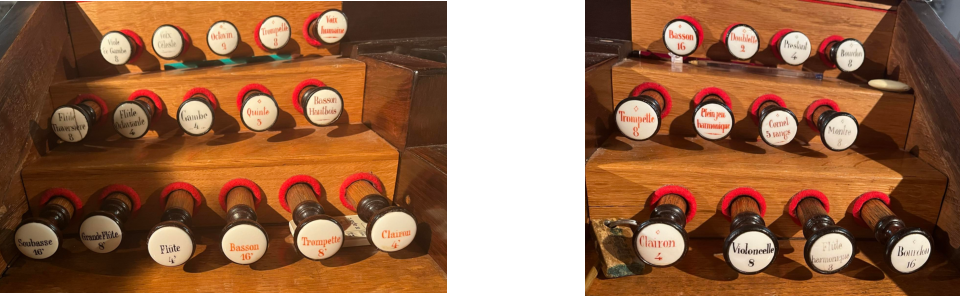
II/29 - mechanical traction
stoplist








Organs of Paris


ORGANS OF PARIS © 2026 Vincent Hildebrandt
C1
Thanks to a donor, the parish received the present Grand
Organ, built by Cavaillé-Coll in 1863.
Originally, it was not intended for this church. It was probably
meant for a convent near Saint-Omer, but the original
specification, the case, and even the finely crafted bench
(with lyres on the sides) suggest a salon organ. It had 22
stops on two 54-note manuals and a 25-note pedalboard,
used only by coupling to the manuals.
It was overhauled in 1881 by Cavaillé-Coll.
In 1904, Charles Mutin carried out an overhaul:
•
he replaced the window console with a detached console;
•
he installed a Barker machine;
•
he extended the pedal compass to 30 notes;
•
he added a 16' Soubasse and an 8' Flute, using part of the
façade pipes, which were then unused;
•
in the Récit, the Clairon was shifted to Trompette, and the
Piccolo was replaced by a Nazard, marked as Quinte on
the console.
In 1928, restoration work was entrusted to Gaston
Gutschenritter:
•
the manuals were extended to 56 notes;
•
a 4' pedal Flute was added;
•
a Barker machine was added to the Grand Orgue.
In 1943, further work was carried out by Gutschenritter:
•
he added a 32' Soubasse to the pedal, with the first
octave borrowed from the 16' Soubasse, completed by 12
pipes of 10 2/3' Quinte;
•
the voicing was adjusted, especially for the Plein-Jeu and
Cornet;
•
the organ’s original pitch was 435 Hz, and it was raised to
440 Hz, probably by Gutschenritter or Haerpfer.
Between 1982 and 1985, a further overhaul was carried out
by Haerpfer, Gutschenritter-Masset. The pedal division was
rebuilt with mechanical transmission.
In 1995–1997, restoration was carried out by Daniel Kern. A
new pedal division was installed, and the voicing was partly
reworked.

Organistes titulaires
Lucile Dollat et Louis Jullien
Parish website
Photos
buffet : Hilaire Champeaux (facebook)
console : Vincent Hildebrandt
1863 - Cavaille-Coll (1)
1881 - Cavaille-Coll (6)
1904 - Mutin (5)
1928 - Gutschenritter (6)
1943 - Gutschenritter (3b)
1984 - Gutschenritter-Masset/Haerpfer (6)
1997 - Kern (5)
II/29 - mechanical traction
stoplist
